ZENITH Maschinenfabrik GmbH

Why Concrete Blocks Crack and How to Prevent Cracking Problems

2026-06-15 0 Leave me a message

Cracking is one of the most common and costly problems in concrete block manufacturing. Whether a factory operates a semi-automatic brick machine or a fully automatic block making machine, cracked concrete blocks can seriously affect product strength, appearance, customer satisfaction, and long-term profitability.


Concrete Blocks


For manufacturers, cracked blocks are far more than simple product defects. They lead to wasted raw materials, increased cement consumption, higher labor costs, production interruptions, and reduced market competitiveness.

In modern concrete block production, cracks rarely result from a single issue. Instead, they are usually caused by a combination of unstable raw materials, incorrect moisture control, poor vibration performance, inadequate curing, hydraulic instability, mould wear, and inconsistent production management.

Understanding these root causes is essential for improving concrete block quality and reducing production losses.


1. Incorrect Moisture Content Causes Concrete Block Cracks and Strength Problems

Water content directly affects the forming quality and structural stability of concrete blocks.

When excessive water is added into the concrete mix, the blocks may initially appear compact and smooth. However, during curing, rapid moisture evaporation creates internal shrinkage stress, often leading to surface cracks, edge fractures, or deformation.

On the other hand, insufficient water prevents proper cement hydration and weakens internal bonding strength. As a result, the blocks become brittle and are more likely to crack during stacking, transportation, or construction.

In many factories using a block machine or brick making machine, unstable aggregate moisture remains one of the most overlooked production problems.


Important Note:

Concrete block production generally requires semi-dry concrete mixtures rather than highly fluid concrete. Proper moisture control helps improve block density, dimensional stability, and crack resistance.


2. Poor Aggregate Gradation Causes Weak Concrete Blocks and Cracking Problems

Raw material quality plays a critical role in preventing concrete block cracking.


Concrete Blocks


If aggregates contain excessive clay, impurities, or inconsistent particle sizes, internal voids will form inside the concrete structure. These weak points reduce compressive strength and increase the possibility of cracking under load.

Similarly, low-quality sand or unstable cement can negatively affect bonding performance inside the block.

Even an advanced QGM block making machine cannot compensate for poor raw material management.


Factories producing high-quality crack-resistant concrete blocks usually maintain strict control over:

●Aggregate grading

●Moisture consistency

●Cement proportion

●Material cleanliness

●Sand quality

Stable block production always begins with stable raw materials.


3. Poor Vibration and Compaction Reduce Concrete Block Strength and Density

Vibration performance is one of the most important factors influencing concrete block strength.

If vibration force is insufficient or unevenly distributed, trapped air pockets remain inside the concrete blocks. These internal voids reduce density, weaken structural integrity, and significantly increase cracking risk.

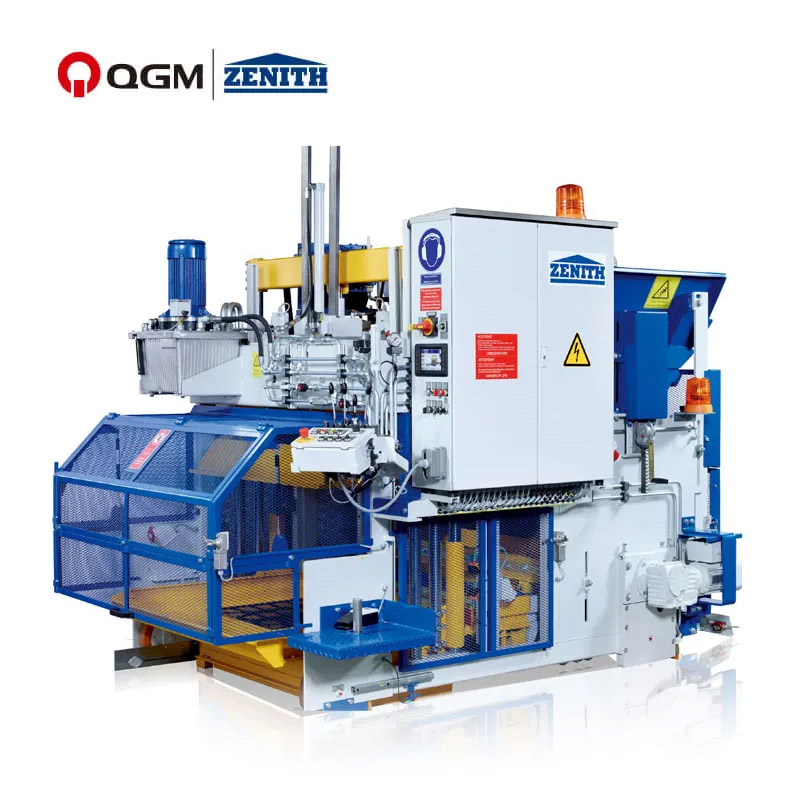
This is why QGM block making machines focus heavily on vibration technology optimization.


Concrete Blocks


QGM adopts an advanced four-shaft vibration system with externally mounted eccentric shafts. This design improves vibration transmission efficiency, enhances concrete compaction uniformity, and reduces energy loss during the forming process.


As a result:

●Concrete block density becomes more consistent

●Internal voids are reduced

●Crack resistance improves

●Cement consumption decreases

●Product quality becomes more stable

For modern concrete block manufacturing, vibration quality is often more important than machine speed alone.


4. Poor Curing Conditions Cause Concrete Block Cracks and Strength Reduction

Many manufacturers focus heavily on production output while neglecting curing management.This is a major mistake.


Concrete Blocks


Concrete strength develops through continuous hydration, not simply through drying. If freshly produced blocks are exposed to strong sunlight, high temperatures, wind, or rapid dehydration, surface shrinkage occurs faster than internal hydration development.

This uneven stress distribution frequently causes cracking.


Proper curing conditions should include:

●Stable humidity

●Controlled temperature

●Sufficient curing time

●Protection from rapid moisture loss

●Consistent water retention

In hot-climate regions especially, curing management is just as important as block machine performance.


5. Mold Wear Leads to Concrete Block Cracking and Poor Product Quality

Mould precision directly affects concrete block density, shape consistency, and structural stability.


Concrete Blocks


As moulds wear over time, uneven pressure distribution begins to occur during forming. This can result in:

●Uneven block density

●Edge damage

●Surface defects

●Dimensional inconsistency

●Stress concentration inside the blocks

These issues significantly increase cracking risks during transportation and installation.


QGM moulds are manufactured according to high-precision industrial standards and are compatible with multiple concrete block production systems. QGM moulds undergo professional heat treatment processes, with hardness controlled at approximately HRC 60–63 to improve wear resistance and service life.

High-quality moulds are essential for maintaining stable concrete block quality and reducing production defects.


6. Unstable Hydraulic Systems Reduce Concrete Block Density and Production Stability

Hydraulic performance directly influences pressure stability during concrete block forming cycles.

If hydraulic pressure fluctuates frequently, some blocks may become over-compacted while others remain structurally weak. This inconsistency creates unstable block strength and increases cracking probability.


QGM hydraulic systems utilize high-performance proportional control technology to ensure:

●Stable pressure output

●Faster response speed

●Smooth forming cycles

●Improved compaction consistency

●Long-term production stability

For factories operating in high-temperature environments, optional oil cooling systems help maintain hydraulic oil stability and reduce overheating-related pressure fluctuation.

Reliable hydraulic coordination is critical for fully automatic block making machine production lines.


7. Early Handling and Stacking Cause Concrete Block Cracks and Damage

Freshly produced concrete blocks remain fragile during the early curing stage.


Concrete Blocks


If blocks are transported, stacked, or palletized too early, microcracks may develop before the concrete fully gains strength. These tiny cracks may not be immediately visible but often expand during storage, delivery, or construction.

Efficient concrete block factories understand that production speed must be balanced with proper curing time.

Stable production is not simply about making blocks faster — it is about producing stronger and more durable blocks consistently.


8. Poor Production Management Reduces Concrete Block Quality and Efficiency

Even advanced automation systems require disciplined operational management.

Incorrect machine settings, inconsistent feeding, neglected maintenance, and poorly trained operators can gradually destabilize the entire production process.

Modern QGM block making machines integrate intelligent PLC control systems, touchscreen operation, and remote monitoring technology to improve production stability and reduce human error.


Through real-time monitoring and data analysis, operators can:

●Optimize production parameters

●Monitor machine performance

●Improve vibration consistency

●Reduce material waste

●Maintain stable block quality


Concrete Blocks


FAQ: Common Concrete Block Cracking Problems and Solutions

1. Why do concrete blocks crack after curing?

The most common reasons include improper moisture content, insufficient curing, weak compaction, unstable raw materials, and poor vibration performance.


2. Can mould wear cause concrete block cracking?

Yes. Worn moulds can create uneven density distribution and dimensional stress concentration, increasing the risk of cracks and structural defects.


3. Does vibration quality affect concrete block strength?

Absolutely. Proper vibration improves concrete density, removes internal air voids, and significantly enhances crack resistance.


Conclusion

Concrete block cracking is not simply an appearance issue. In most cases, it is a visible sign of deeper production instability within the manufacturing system.

QGM block making machine combines vibration technology, hydraulic control, intelligent automation, mould precision, curing management, and raw material coordination into one integrated production solution.


Concrete Blocks


When every stage of the production process remains stable and properly controlled, concrete block cracking can be significantly reduced while product quality, strength, and production efficiency continue to improve.

Ultimately, the most competitive concrete block manufacturers are not simply those producing at the highest speed. They are the factories capable of delivering consistent quality, stable performance, and long-term reliability every single day.

Related News
Leave me a message
X
We use cookies to offer you a better browsing experience, analyze site traffic and personalize content. By using this site, you agree to our use of cookies.Privacy Policy
RejectAccept